
Italia Conti Dubai AI Readiness Audit Case Study
Most websites are not invisible to AI tools. They are just under-explained, poorly structured or technically awkward for machines to interpret.
That was the useful lesson from a recent AI Readiness & Agentic Website Audit for the Italia Conti Dubai website project.
The website was already clear enough for AI assistants to understand the basic business. ChatGPT, Gemini and Claude could identify it as a Dubai-based performing arts school for children and young people aged 5 to 18. They understood the broad offer: dance, acting, singing and musical theatre training.
But general understanding is not the same as proper AI readiness.
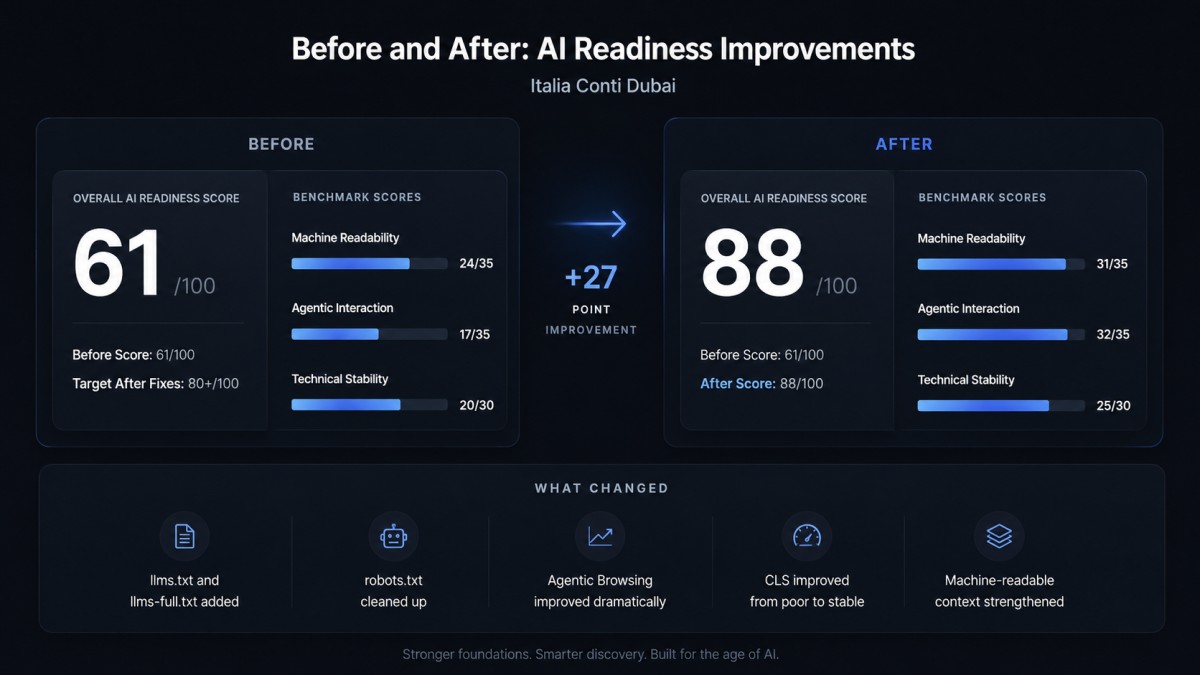
The site was understandable, but not strongly prepared for AI-assisted discovery, machine interpretation or agentic browsing. The first audit gave it an overall AI readiness score of 61/100.
After the first round of fixes, the score improved to 88/100.
What an AI readiness audit actually checks
An AI readiness audit reviews whether a website is easy for modern systems to read, understand and interact with. It looks at machine-readable content, structured information, accessibility signals, crawler access, layout stability, contact paths, forms, internal links and technical performance.
The aim is not to promise AI rankings or guaranteed visibility in ChatGPT, Claude, Gemini or Google.
The aim is more practical: make the website clearer, more stable, more accessible and easier for search tools, AI assistants and automated browsing agents to interpret.
For a service business website, that means AI systems should be able to answer basic questions accurately:
- What does this business do?
- Who does it serve?
- Where does it operate?
- Which services or programmes are available?
- Which pages matter most?
- How should someone enquire?
- Can contact and booking routes be identified clearly?
If a human visitor has to hunt for those answers, AI systems will often struggle too.
The starting point: understandable, but not strongly prepared
Italia Conti Dubai was not starting from a broken position.
The business itself was understandable. AI assistants could identify the school, the audience and the broad service offer. The site had useful pages, recognisable navigation and credible content.
The problem was that too much of the useful context had to be inferred.
The initial audit scored the site as follows:
| Benchmark | Before score | What it showed |
|---|---|---|
| Machine Readability | 24/35 | AI tools could understand the business, but important machine-readable signals were missing or weak. |
| Agentic Interaction | 17/35 | Automated agents had weaker support for understanding page structure, enquiry routes and interaction points. |
| Technical Stability | 20/30 | Performance was usable, but layout shift and loading issues reduced stability. |
| Overall AI Readiness | 61/100 | The site was broadly understandable, but not yet strongly prepared for AI-assisted discovery or agentic browsing. |
The main issues found
The audit identified five priority issues.
1. Missing AI-readable files
The site did not have a working llms.txt proposal file or llms-full.txt file available to support AI interpretation.
These files are not magic ranking tools. Their value is simpler. They give AI systems a clear, structured summary of the business, key pages, services, audience, location, enquiry routes and recommended interpretation.
Without them, AI tools have to infer more from the visible website alone.
2. Crawler restrictions
The original robots.txt setup appeared to restrict several major AI crawlers. This needed to be reviewed against Google's robots.txt guidance and the business's own visibility goals.
This is partly a technical decision and partly a policy decision. Some businesses may choose to restrict certain crawlers. Others may want stronger AI-assisted discovery. The issue is not whether every crawler should be allowed. The issue is whether the policy supports the business goal.
For this site, stronger AI-assisted discovery was the aim, so the crawler policy needed review.
3. Weak machine-readable enquiry paths
AI tools could understand the business, but they were less consistent when extracting contact, booking and enquiry information.
That matters because discovery is only half the job.
An AI assistant may be able to explain what a business does, but still fail to guide someone towards a trial booking, audition enquiry or contact form if those routes are not clearly exposed.
4. Thin homepage context
The homepage was visually branded, but relatively thin from a machine-readable content perspective.
For people, a strong visual homepage can work well. For AI systems arriving cold, the page also needs clear explanatory content. It should state who the business is, who it helps, what it offers, where it operates and what the visitor should do next.
5. Layout instability
The initial technical audit showed poor Cumulative Layout Shift, with CLS recorded at 0.307.
Layout shift affects users because elements move during loading. It can also affect automated browsing tools because interaction targets may not be stable when the page first loads.
What was fixed
The first round of fixes focused on practical improvements rather than a visual redesign.
The aim was to strengthen the structure behind the website, so AI systems, search engines and automated browsing tools had clearer signals to work with.
AI-readable files were added
A working llms.txt file was added to provide a concise AI-readable summary of the business.
An expanded llms-full.txt file was also added to provide deeper structured context. This helped explain the business, services, audience, key pages and enquiry routes in a format designed for machine interpretation.
One important detail was clarity around brand interpretation. Italia Conti Dubai needed to be understood as the Dubai performing arts school, not confused with the wider historic Italia Conti organisation in the UK.
The crawler policy was cleaned up
The robots.txt file was simplified.
The revised version kept the normal WordPress admin restriction, allowed admin-ajax.php and pointed to the sitemap. The previous restrictive AI crawler rules were removed.
That created a cleaner policy for AI-assisted discovery while still preserving standard WordPress crawler handling.
Agentic browsing support improved
The audit included experimental Agentic Browsing checks using Chrome Canary Lighthouse.
Before the fixes, the Agentic Interaction score was 17/35. After the fixes, it improved to 32/35.
The after-test also returned a perfect Lighthouse Agentic Browsing score. That does not mean every AI agent will interact with the website perfectly. It means the site became much better aligned with the kinds of structure, accessibility and stability signals that automated browsing tools can use.
Technical stability improved
The technical improvements were measurable.
Performance improved from 51/100 to 74/100. Best Practices improved from 96/100 to 100/100. Console errors were fixed.
The clearest improvement was CLS, which moved from 0.307 to 0.02. That took layout shift from poor to stable.
The after result
After the first round of fixes, Italia Conti Dubai moved from a moderate AI readiness score of 61/100 to a much stronger 88/100.
| Benchmark | Before | After | What changed |
|---|---|---|---|
| Overall AI Readiness | 61/100 | 88/100 | +27 point improvement after the first round of fixes. |
| Machine Readability | 24/35 | 31/35 | AI-readable files and clearer machine context improved interpretation. |
| Agentic Interaction | 17/35 | 32/35 | Automated browsing and interaction readiness improved significantly. |
| Technical Stability | 20/30 | 25/30 | CLS improved, console errors were fixed and stability improved. |
ChatGPT and Claude successfully accessed the new llms.txt, llms-full.txt and robots.txt files during the after-test. Gemini could not verify the live files during that test, so that result was treated as a retrieval limitation rather than evidence that the files were missing.
That distinction matters.
AI readiness is not only about what exists on the website. It is also about how different tools retrieve, cache and interpret live content. Technical verification and AI assistant behaviour should be measured separately.
What this means for business websites
This example is useful because it shows the difference between being understandable and being well structured.
This is closely related to the wider question of AI readiness for service business websites, where the website has to explain trust, location, services and enquiry routes clearly.
A website can have good branding, decent copy and a clear business offer, but still make AI systems work too hard.
For businesses in Dubai, the UAE, Liverpool or the UK, this is especially relevant if the website supports enquiries, referrals, bookings, applications or lead generation.
AI tools are increasingly used to summarise businesses, compare options, extract details and guide users towards next steps. If your website does not clearly expose the right information, those tools may miss important context.
They may misunderstand your services. They may fail to identify your contact route. They may not extract fees, locations, booking paths or service differences correctly.
That is not an AI problem alone. It is usually a website clarity problem.
The practical AI readiness checklist
A useful AI readiness review should look beyond one file or one score.
For most service business websites, the checks should include:
- Business clarity: Can the site clearly explain what the business does, who it helps and where it operates?
- Service clarity: Are services explained on crawlable pages, or buried in visual sections, accordions or vague menu labels?
- AI-readable files: Are llms.txt and, where useful, llms-full.txt available and accurate?
- Crawler policy: Does robots.txt support the business's visibility goals?
- Structured data: Is schema markup used sensibly for the organisation, services, FAQs or local context?
- Contact paths: Can AI systems identify the correct enquiry, booking, WhatsApp, phone or form route?
- Accessibility: Are buttons, links, forms and page structure understandable beyond visual design?
- Technical stability: Are layout shift, speed, JavaScript errors and mobile behaviour under control?
- Internal linking: Are the most important pages connected in a way that makes sense for users and machines?
- Freshness: Are key details such as services, fees, locations, dates and contact details kept up to date?
What still needed improvement
The after report was positive, but it did not pretend the site was finished forever.
There were still sensible next steps.
- Add clearer static contact details to the Contact Us page.
- Make fees and term dates easier to extract without relying too heavily on JavaScript or hidden accordion content.
- Add a concise explanatory paragraph near the top of the homepage.
- Improve server response time through caching or hosting-level optimisation.
- Keep llms.txt and llms-full.txt updated whenever services, fees, term dates, contact details or key pages change.
This is why AI readiness should not be treated as a one-off badge.
It is closer to WordPress maintenance and technical improvement. The site needs to stay aligned with the business as it changes.
Why this works as a technical case study
This example is not about a new brand, a redesigned homepage or a full rebuild. It is a technical before-and-after showing what was measured, what was weak, what was fixed and what improved.
That makes it useful for any business that already has a working website, but wants to know whether the site is clear enough for search engines, AI assistants and automated browsing tools.
Where this fits with website design and maintenance
AI readiness does not replace good website design, proper WordPress development, clear service pages or practical maintenance.
It sits on top of them.
If a website is unclear for people, it will usually be unclear for machines. If it is unstable, slow or full of hidden content, automated systems may struggle to interpret it. If contact routes are vague, AI assistants may be able to summarise the business but fail to guide users towards an enquiry.
For some businesses, the right next step is a focused AI readiness audit and a few technical fixes.
For others, the audit may show that the site needs a wider website development project, clearer service structure or ongoing WordPress maintenance.
The best answer depends on the site, the business model, the technical condition, the market and how important the website is to enquiries.
FAQs
What is an AI readiness audit for a website?
An AI readiness audit checks whether a website is clear, structured, accessible and technically stable enough for modern search tools, AI assistants and automated browsing agents to interpret. It can include content clarity, schema, robots.txt, llms.txt, accessibility, page speed, layout shift, contact routes and machine-readable business context.
Does AI readiness guarantee better rankings in Google or AI tools?
No. AI readiness does not guarantee rankings, visibility or recommendations from ChatGPT, Claude, Gemini, Google or any other system. It improves the conditions that help machines understand the website more accurately. Outcomes still depend on content quality, technical condition, competition, authority, search demand and ongoing execution.
Should Dubai businesses add llms.txt to their website?
Many Dubai service businesses should consider it, especially if their website needs to explain services, locations, audiences, enquiry paths and key pages clearly. llms.txt is not a magic ranking file. It is a structured context file that can support AI interpretation when implemented properly and kept up to date.
Is AI readiness only relevant for WordPress websites?
No. AI readiness applies to any website platform. WordPress websites are common because they are widely used by service businesses, clinics, schools, consultants and agencies. The core principles are the same across platforms: clear content, accessible structure, crawlable information, stable layouts and reliable enquiry paths.
How often should a website AI readiness audit be repeated?
A light review is useful after major website changes, new service launches, redesigns, contact form changes, content restructuring or technical updates. For websites that rely heavily on search, referrals or enquiries, periodic review can help ensure the site remains clear for people, search engines and AI-assisted browsing tools.
Final thought
The Italia Conti Dubai example shows the real purpose of AI readiness work.
The aim is not to chase vague AI visibility promises. The aim is to make a website clearer, more structured, more accessible and more technically reliable.
That helps people. It helps search engines. It helps AI assistants and automated browsing tools interpret the website with less guesswork.
If your website already matters to your enquiries, referrals or search visibility, it is worth checking before AI tools assess your content on your behalf.
If you want a practical review of how well your website can be understood by AI assistants, search tools and automated browsing agents, book an AI readiness audit before AI tools shape more buying decisions.