
Website conversion audit Dubai: find the lost handoff
A prospect lands on a Dubai consultancy’s service page after a referral. The page explains the service well enough. They scroll on a phone, look for proof, find a WhatsApp button, hesitate because the case studies are buried, then decide to use the contact form instead.
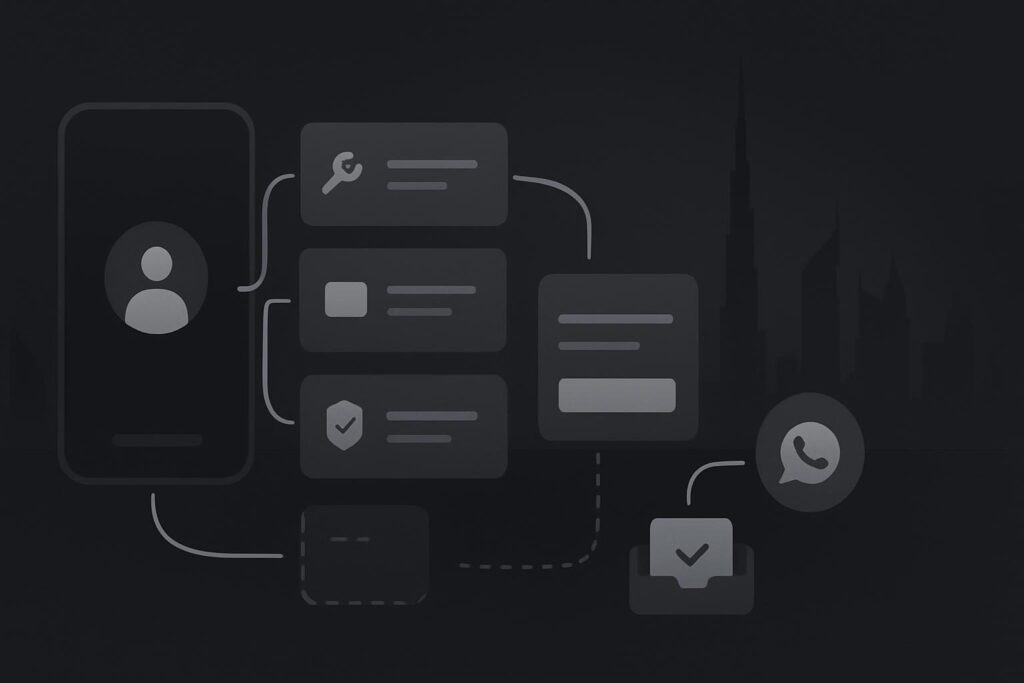
The form appears to submit. A green success message pops up. The prospect gets on with their day. Nobody at the consultancy sees the enquiry because the form still sends mail to an old inbox nobody monitors.
That is a conversion problem, even though the page, button and form all appear to be doing their jobs.
Follow the route, not the button
A website conversion audit in Dubai checks how a potential customer moves from first interest to a usable enquiry reaching the right person. It reviews intent, service clarity, proof, calls to action, mobile behaviour, form or WhatsApp functionality, confirmation messaging and internal receipt. It is useful even with modest traffic because one real journey can expose an unclear or broken handoff.
Businesses often jump straight to a redesign, a new CTA colour or a shorter form. Fair enough, those things can matter. But changing a button before checking where the enquiry goes is a bit like repainting a reception desk while the phone line is unplugged.
The larger issue is frequently the join between pages, forms and people. A prospect needs enough confidence to act, the website needs to accept the action properly, and somebody in the business needs to receive and handle it.
Run the enquiry-path audit one route at a time
Pick a service that matters commercially. Use a real device, preferably a phone on a normal mobile connection, and follow the route as a prospect would. Do not begin inside WordPress admin where everything is familiar and forgiving.
For a consultancy, the route may be service page, evidence, contact option, form submission, confirmation, inbox receipt and sales follow-up. For a clinic, it may include practitioner information, availability and booking. The route changes, but the checks are much the same.
| Decision point | What the prospect needs | Failure signal | Responsible owner |
|---|---|---|---|
| Landing page | To recognise the service and whether it fits their problem | Generic opening copy or several competing offers | Marketing or service lead |
| Service clarity | To understand scope, audience and likely next step | Visitor must hunt through menus to work out what is being offered | Business owner or content lead |
| Proof | Enough evidence to trust the business before contacting it | Testimonials, case studies or credentials appear after the main CTA | Marketing or account lead |
| CTA visibility | An obvious route to enquire without excessive scrolling | Mobile button is obscured, vague or sends users to the wrong action | Website manager |
| Form or WhatsApp action | A working, low-friction way to make contact | Required fields misbehave, link opens the wrong number or form stalls | Developer or support owner |
| Confirmation | Clear proof that the request has been accepted | Button changes colour but no useful completion message appears | Developer or website manager |
| Internal receipt | A named person receives and can act on the enquiry | Mail lands in spam, an old inbox or an unowned shared mailbox | Sales or operations lead |
Check the page before asking for the enquiry
People do not arrive pre-sold because they clicked an ad or were sent a referral. They still need to work out whether you help businesses like theirs, what the service involves and why they should trust you with the next conversation.
On mobile, proof needs to appear before or alongside the main action. If the WhatsApp CTA is the first prominent thing on the screen but the reason to use it appears much later, the website is asking for a commitment before doing its own work.
Check the following on the actual service page:
- Can a visitor identify the service, audience and location without reading every paragraph?
- Does the page answer the practical questions that commonly delay contact?
- Are testimonials, relevant examples, credentials or process details visible before the main CTA?
- Does the CTA say what happens next, rather than merely saying Contact us?
- Is the mobile layout readable without sticky bars covering buttons or form fields?
If the audit shows that the route is structurally muddled rather than technically broken, the next job may be to restructure the enquiry journey through considered website design in Dubai. There is no need to rebuild every page because one handoff has failed, but there is little point polishing a layout that cannot explain the offer in the right order.
Test delivery separately from submission
A contact form success message proves only that the browser received a success state. It does not prove an email reached the right inbox, avoided spam filtering, or created a record in the CRM.
Send a controlled test using an address you can check. Record the time, page URL, device, form fields completed, confirmation shown and receiving mailbox. Then check the primary inbox, spam folder, forwarding rules and any CRM or automation destination. SMTP settings, sender-domain alignment and an old mailbox alias are boring details, but they are usually more useful than a debate over whether the button should be blue.
If a form is unreliable, use a proper set of WordPress contact form repair checks before changing plugins at random. The same applies to measurement. If you cannot tell whether the form submission or WhatsApp click is being recorded consistently, review broken analytics tracking for website enquiries alongside the route itself.
Assign an owner to every handoff
A conversion route crosses several responsibilities. Marketing may own the copy, a developer may own the form, and sales may own the reply. When nobody owns the joins, qualified enquiries can disappear in a gap that no single team considers theirs.
Write down one accountable owner for each row in the audit table. They do not need to perform every task themselves. They do need to know what a working outcome looks like and who to involve when it is not happening.
Prioritise the repair path
- Fix broken delivery first. Repair forms, wrong WhatsApp links, inbox routing and confirmation failures before changing page design.
- Make the next action visible on mobile. Remove obstructed controls, ambiguous CTAs and unnecessary form friction.
- Move trust signals earlier. Put relevant proof near the point where a visitor is being asked to enquire.
- Clarify the service route. Give each important service a clean page and a sensible action, rather than sending everyone to a general contact page.
- Review internal response handling. A received enquiry still needs a timely, useful human response. The website cannot carry that bit for you.
Questions worth asking during a conversion audit
What does a website conversion audit inspect?
It inspects the full route from a visitor arriving with intent through to a business receiving a usable enquiry. That includes page messaging, proof, calls to action, mobile usability, forms, WhatsApp links, success states, email delivery, tracking and internal ownership. The aim is to identify the point where confidence, functionality or responsibility drops away.
Does a conversion audit require large traffic volumes?
No. Larger traffic volumes can provide more behavioural data, but an audit can begin with direct route testing and a close review of the pages that carry commercial intent. A low-volume service business may only need a small number of missed or mishandled enquiries for the problem to matter.
Before paying for more traffic or approving a full rebuild, follow one enquiry from landing page to receipt before redesigning the whole website with Standish Services.