
WooCommerce developers in Liverpool: follow one order
The product pages are often the easy bit. A tidy catalogue, a smart header and a few decent photographs can make a small shop look finished long before the difficult work has been checked.
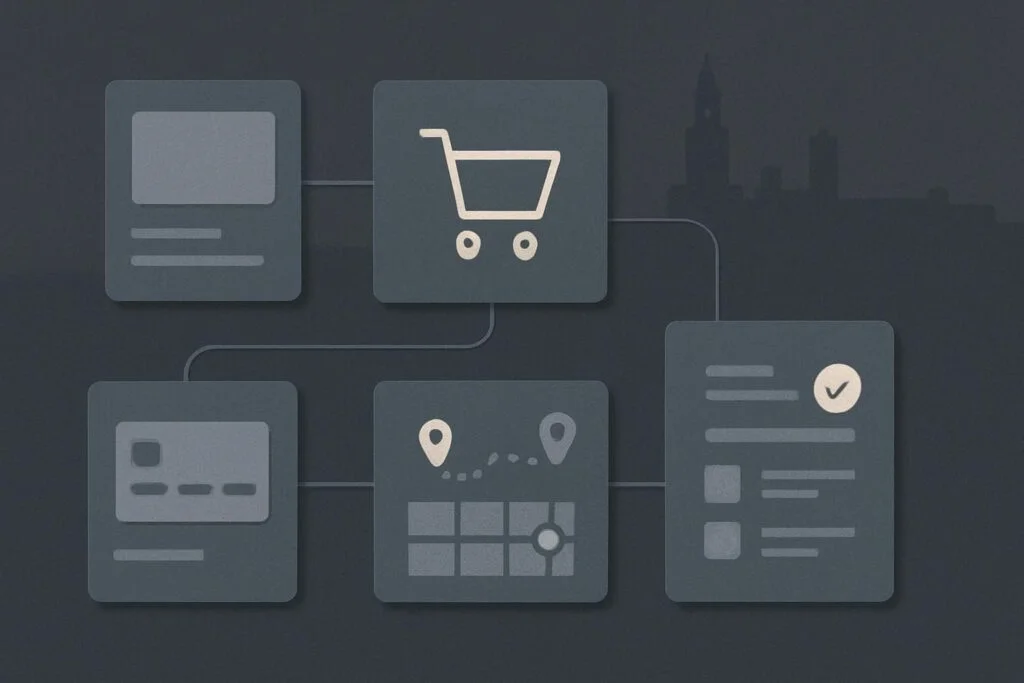
The difficult work starts when a customer chooses a product, uses a particular postcode, selects delivery, pays with their preferred card, triggers a stock update and expects the right confirmation to reach both inboxes. That is the part worth discussing when comparing a WooCommerce development company in Liverpool.
Judge the build by one complete order
A WooCommerce developer should be assessed against the store’s actual order journey, not just their portfolio screenshots or the number of product pages in the quote. The relevant scope includes product and basket behaviour, checkout rules, payment processing, shipping logic, tax settings where required, stock handling, order notifications, third-party integrations, testing arrangements and responsibility after launch. A small catalogue can still need substantial development when those parts are bespoke.
Take a Liverpool retailer with a fairly modest storefront. It may need card payments, local delivery rules, stock synchronisation with another system and a trade-account route for approved customers. None of that necessarily makes the homepage complicated. It does make the order journey more involved than a standard shop setup.
Test the whole order journey before judging the supplier by the storefront alone.
Start with the point where the customer pays
Payment is not simply a gateway logo in the footer. Ask how the supplier will handle the payment method you need, what happens when payment fails, and whether the checkout has custom fields, address rules or account conditions that could affect the transaction.
A developer does not need to promise that every payment provider behaves perfectly forever. They should, however, be able to explain how they will test the relevant payment route before launch and what access is needed to do it properly.
- Which payment gateway or gateways are required?
- Will the customer remain on the site or be redirected to the provider?
- Are guest checkout, saved cards, deposits, subscriptions or trade accounts involved?
- Who owns the gateway account, API credentials and recovery access?
- How will failed, cancelled and successful payment states be checked?
It is worth asking about test mode as well. A staging checkout that cannot use the same gateway settings, delivery rules or account logic as live may still be useful, but its limits should be clear. Otherwise somebody declares it tested, then finds the real problem on the live payment route. Bit late for a victory lap.
Then follow the order into fulfilment
Once payment is accepted, the store still has work to do. Shipping rules must return the right options, stock should change in the expected place, staff need a usable order record, and the customer and business need the correct emails.
For local delivery, ask the supplier to describe the actual rule. Is eligibility based on postcode, distance, order value, delivery day, product type or a combination of those? A vague line such as local delivery setup can cover anything from one flat-rate method to a custom ruleset with several awkward edge cases.
| Order stage | Question for the supplier | Ownership to confirm |
|---|---|---|
| Product selection | Are products simple, variable, bundled or restricted by customer type? | Who manages catalogue data and imports? |
| Checkout | Which fields, validation rules and account flows are required? | Who approves changes to custom checkout code? |
| Payment | Which gateway states will be tested? | Who controls merchant accounts and credentials? |
| Delivery | How are postcodes, rates, collection and exceptions handled? | Who maintains shipping rules after launch? |
| Stock and fulfilment | Does stock sync with another system or update manually? | Who owns the integration and support contact? |
| Notifications | Will customer and staff emails be checked in real inboxes? | Who owns the sending domain and SMTP service? |
That final point catches more stores than it should. WooCommerce can create an order successfully while the confirmation email fails to arrive because the sender domain, SMTP service or recipient inbox is wrong. Seeing an order in wp-admin is not proof that the warehouse, sales team or customer has been informed.
Find out what is configuration and what is development
Every WooCommerce project is not broadly the same merely because WooCommerce is involved. Some requirements can be handled through standard settings and well-supported extensions. Others need custom code, API work, a middleware service or changes to an existing ERP, CRM or stock system.
Ask suppliers to separate these items in the quote. You want to know what is being configured, which paid extensions are being used, what custom code will be written, and what depends on an external supplier. This makes it easier to compare two proposals that otherwise both say something reassuringly vague like ecommerce setup.
Questions worth asking about custom code
- What business rule does the code solve?
- Where will it live: a custom plugin, child theme or code-snippet tool?
- Will it be documented for a future developer?
- What WooCommerce, theme or extension behaviour does it depend on?
- What happens if a related plugin changes or is replaced?
A five-line custom rule can control trade pricing, delivery fees or account approval. It may work well. It should still have a named owner and a reason for existing.
Do not accept staging as a decorative extra
A supplier should explain how changes will be tested before they reach customers. For a WooCommerce store, staging needs care because it may not match live payment settings, stock data, shipping integrations or customer accounts exactly.
The useful question is not simply whether there is a staging site. Ask what it mirrors, what cannot be mirrored safely, and how a release is checked afterwards. Test orders should cover a realistic mobile journey, the relevant payment state, shipping selection, order status, stock movement and email delivery.
There should also be a rollback plan. If an update or new checkout rule creates a problem, the supplier needs a sensible route back rather than a loose suggestion to try disabling things during trading hours.
Compare ownership, not only delivery
Post-launch support is where quotation gaps tend to become visible. A developer may build the store competently but leave licences, hosting access, gateway accounts, domain settings, SMTP credentials and third-party integrations in a collection of personal logins. That is an avoidable nuisance until an urgent change is needed.
Use the WooCommerce development Liverpool service route when you need to define a build around the store’s real requirements, rather than a generic shop package. For the ongoing side, UK website maintenance for WordPress and WooCommerce can cover planned checks and practical support once the store is live.
A supplier comparison checklist to take into each call
- Describe one typical order from first visit through fulfilment.
- List every system involved: payment gateway, shipping service, stock system, CRM, accounting tool, email service and any trade-account process.
- Mark which requirements are standard configuration, paid extensions, custom code or external integration work.
- Ask how the supplier will test success, failure and edge cases before launch.
- Confirm who owns accounts, licences, code, hosting access, backups and support contacts.
- Get post-launch support boundaries written down, including what happens if testing finds an existing fault.
That approach gives you a far better basis for comparison than asking which supplier can make the nicest product page. The storefront matters, obviously. It just is not the only part handling money, customer expectations and your staff’s Monday morning.
Send your WooCommerce brief by email to define the store requirements and ownership before comparing WooCommerce development quotes.